
Toronto ACORN announces priorities for the 2026 Toronto City Budget
Posted September 26, 2025
Toronto, ON — On Friday, September 26, 2025, Toronto ACORN announced its budget recommendations in advance of the consultations for the 2026 Toronto City Budget. On behalf of our low-income and working class membership, we are calling on the City of Toronto to give RentSafe teeth, beat the heat, provide internet for all, protect and expand affordable housing, prevent tenant displacement, defund police and fund communities.
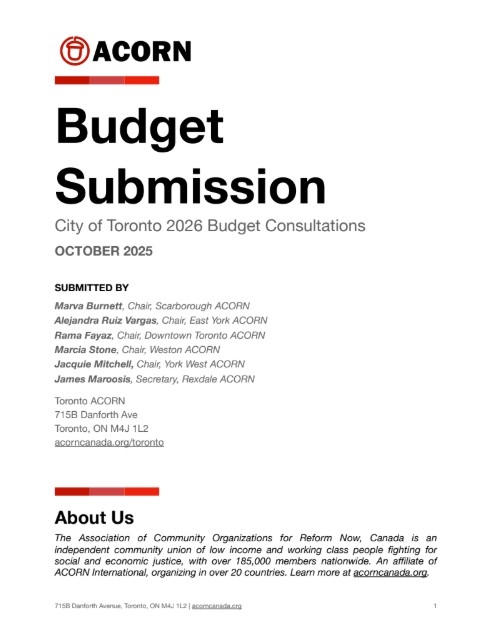
Click here to view Toronto ACORN’s full 2026 City Budget Submission.
Give RentSafe Teeth
The RentSafeTO program is an important tool the City of Toronto has to hold negligent landlords accountable and protect tenants’ right to safe, healthy housing. However, there are glaring gaps between the program’s stated goals and its actual policies and practices. These gaps, from closing service requests without resolution, to failing to issue orders to comply or fines on negligent landlords, severely impact the program’s credibility as a resource that tenants can turn to when they need to. We need the City to give the RentSafeTO program some teeth.
Budget Recommendations
- Increase RentSafeTO registration fees for landlords to $30/unit/year.
- Hire additional RentSafeTO bylaw officers using the additional registration fee revenue, with the long-term goal of a ratio of 1 bylaw officer for every 12.5 buildings registered with RentSafeTO.
- Allocate sufficient funding for the implementation of a colour-coded rating system for the RentSafeTO program, pursuant to motion MM32.23 adopted at the July 2025 City Council meeting.
- Allocate sufficient funding to enable RentSafeTO to hire contractors and conduct remedial action at properties that violate the Property Standards Bylaw.
Beat the Heat
Toronto is getting hotter, and thousands of tenants are still suffering in unsafe indoor temperatures. Currently, there is no provincial legislation mandating a maximum indoor temperature for residential apartment buildings, and the existing municipal bylaw applies only to residential apartment buildings that already provide cooling. The climate crisis will mean extreme heat events will continue to increase in intensity, duration, and frequency. It is well documented that seniors, people with disabilities, racialized people, and low-income people are at a disproportionate risk of heat-related illnesses or death.
The City of Toronto acted quickly in 2025 to implement a free air-conditioner program for low-income seniors, after Toronto ACORN and our allies called for emergency measures before the start of summer. This is a great step in the right direction, and we hope to see the City continue to act on extreme heat.
Budget Recommendations
- Make the Air Conditioner Assistance Program permanent, and fold the provision of air conditioners under the City’s Hardship Fund into this program to avoid duplication and confusion.
- Budget $1,250,000 to expand the size and eligibility of the Air Conditioner Assistance Program, providing 1500 air conditioners to low-income seniors and 1000 air conditioners to other low-income demographics for a total of 2500 units.
- Eliminate all Toronto Transit Commission fares during extreme heat events, as declared by Environment & Climate Change Canada.
Provide Internet for All
In an increasingly online world, access to the internet is a necessity, not a luxury. However, many low-income communities in Toronto struggle to get online. In 2021, 34% of households in the city reported having difficulty making their monthly internet bills, and the majority of those struggling to make their payments are low-income, newcomer, single parent, and Black and racialized Torontonians. The removal of free public Wi-Fi on the TTC subway system was a major blow to internet access and safety on public transit. The City of Toronto has the potential to help to bridge the digital divide by investing in infrastructure to keep our communities connected.
Budget Recommendations
- Budget $17 million to restore and expand free public Wi-Fi in the TTC subway system, making it available in station concourses, platforms, and subway tunnels.
- Fund, launch, and maintain a publicly-owned broadband network.
- Fund the installation of public-owned broadband fibre connections in the City’s 65,000 housing units being created under the HousingTO 2020-2030 Action Plan.
Protect & Expand Affordable Housing
Safe, stable, healthy, and accessible housing is increasingly out of reach for many Torontonians. With the Legislative Assembly of Ontario failing to implement stronger rent control laws, including banning above-guideline rent increases and implementing vacancy control, the responsibility falls to the City of Toronto to use what tools it has to provide affordable housing for Torontonians.
Budget Recommendations
- Mandate full rent control, including vacancy control, in perpetuity on all new housing developments receiving municipal funding.
- Increase the Vacant Homes Tax to 5%, and tax all vacant units in multi-residential buildings.
- Use this additional revenue from the Vacant Homes Tax to increase funding to the Multi-Unit Residential Acquisition program.
- Earmark funding to purchase the rental property at 500 Dawes Road, Toronto, ON M4B 2G1 and create a community land trust to operate the building.
Prevent Tenant Displacement
Ontario’s weak rent control laws and lack of strong legislation preventing renovictions and demovictions put many tenants at risk of losing their homes and being evicted—a traumatizing and destabilizing experience for anyone. The City of Toronto should continue to invest in the Toronto Rent Bank.
Budget Recommendations:
- Double funding for the Toronto Rent Bank to provide financial assistance to up to 5,500 people per year.
- Expand eligibility for the Toronto Rent Bank, including to those on Employment Insurance and those Ontario Works and Ontario Disability Support Program recipients who are denied support from the provincially-funded Housing Stabilization Fund.
Defund Police, Fund Communities
The Toronto Police Service budget is one of the largest line items in the City of Toronto’s budget. Meanwhile, upstream programs, services, and supports that can reduce crime and build community are underfunded. Real equity for our communities means meaningful investments in our communities, not more policing.
The ‘bubble zone bylaw’ adopted by City Council in May 2025 is a slap in the face to organizers, activists, and everyday Torontonians. We are already seeing the bylaw being used to crack down on Palestine solidarity actions, and with the federal government considering similar legislation, the City of Toronto must step up to protect the freedom of expression. Spending $1.8 million to restrict the right to protest at a time when our social services and infrastructure are crumbling from austerity displays a grave misalignment of priorities.
Budget Recommendations:
- Redirect 10% of the Toronto Police Service budget to upstream programs and services, such as:
- Community-led alternatives to policing and the criminal justice system;
- Anti-racism education;
- Programs identified in the Toronto Youth Equity Strategy;
- Childcare;
- Affordable housing;
- Toronto Rent Bank and the Toronto Tenant Support Program;
- Skills training and employment counselling; and
- Food security.
- Direct the City Manager’s Office and Transportation Services to cease all funding for the implementation and enforcement of the ‘bubble zone bylaw.’ Repeal the law.
Click here to view Toronto ACORN’s full 2026 City Budget Submission.